

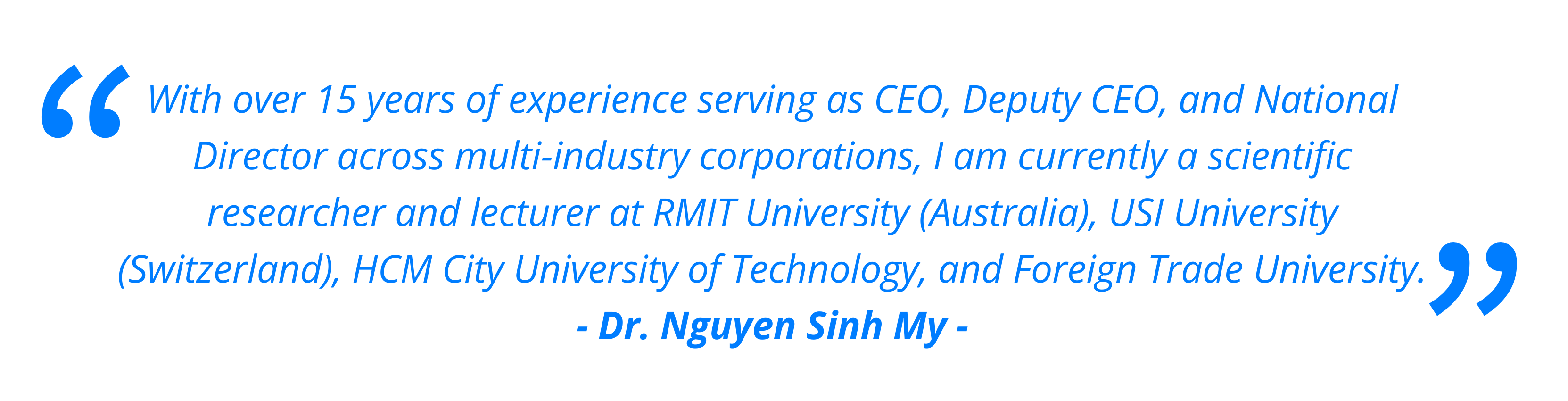
By Dr. Nguyễn Sinh Mỹ, January 13, 2026
In an era where scientific research is increasingly globalized, proficiency in research and academic English is no longer an additional advantage, but a foundational competency for master’s and doctoral students. This competency creates a clear distinction not only in learning quality, but also in academic standing, program completion speed, and long-term career prospects.
First and foremost, the most fundamental benefit of academic English proficiency lies in access to global knowledge. The majority of high-impact research outputs—particularly Q1/Q2 journal articles, seminal academic books, and advanced research reports—are published in English. When postgraduate students master research English, they are able not merely to read for comprehension, but to read critically, synthesize diverse academic perspectives, and build a solid theoretical foundation for their own research.
Second, academic English significantly enhances the quality of research thinking. Writing in accordance with academic conventions compels learners to think logically, structure arguments coherently, and clearly distinguish between description, analysis, and critique. Through sustained academic writing practice, students gradually develop mature scholarly thinking, learning how to formulate research questions, identify research gaps, and defend their arguments convincingly before academic committees.
For doctoral students, this advantage is particularly evident in their ability to publish internationally. Even high-quality research may struggle to gain acceptance in international journals if it is poorly presented in English. By mastering academic English, PhD candidates can proactively write journal articles, respond effectively to reviewers’ comments, participate in international conferences, and progressively build a globally oriented academic profile.
Moreover, strong academic English skills enable postgraduate students to accelerate program completion. They become less dependent on language correction, reduce the number of revision cycles with supervisors, quickly grasp academic expectations, and avoid common linguistic and structural errors that often lead to lower thesis evaluations. As a result, they save time and financial resources while also alleviating psychological pressure throughout the research process.
Finally, in the long term, proficiency in research and academic English opens up exceptional career opportunities, including teaching at international institutions, participating in research projects, providing academic consultancy, or working in global academic–industry environments. It can therefore be asserted that, for master’s and doctoral students, academic English proficiency is a strategic lever that transforms knowledge into sustainable academic and professional value.



 Users Today : 30
 Total Users : 2020793
 Views Today : 124
 Total views : 2940004


